Self Healing Concrete
Self Healing Materials is a new research area that gets a lot of attention in recent years. Self Healing Concrete is a term that is used for cement-based materials that repair themselves after the material or structure gets damaged due to some sort of deterioration mechanism.
In this blog we will update you on the progress of the Self Healing Concrete projects running in the section Materials & Environment and the Microlab of the faculty of Civil Engineering and Geosciences of Delft University.
This blog contains a description of the running projects that are financed by AgentschapNL, DCMat, STW and industrial partners. Also a page "Literature & Videos" is included where a lot of publications can be found.
Thursday, 1 March 2012
Monday, 27 February 2012
Upscaling Bacterial Concrete
Renee made a nice poster to present her project on upscaling the Bacterial Concrete.
Click on the images to see a larger version.
Microdurability Conference Amsterdam
Did you know that we are organising a conference on Microdurability in April in Amsterdam. There will be several presentations on self healing materials!
Self Healing Concrete visits Malaysia and Indonesia
Next week Erik will be in Malaysia and Indonesia where he is invited to participate in a workshop and a conference on Durability and Sustainabity of Materials. Self Healing Materials will be the topic of his presentations.
Click on the image to find out more on the workshop and click here for the program of the conference in Indonesia. Senot will also be at the conference in Indonesia to present the Porous Network Concrete.
BETONICA Webinar
Today Erik gave a Webinar on Self Healing Concrete and Asphalt for Betonica.
You can watch back the webinar on the website of Betonica.
The presentation you can download here.
You can watch back the webinar on the website of Betonica.
The presentation you can download here.
Injection of Healing Agent.
Senot made a nice movie of the injection of healing agent in the porous network concrete. Enjoy!
Wednesday, 15 February 2012
Thursday, 9 February 2012
WEBINAR self healing 27/02/2012
On 27/02/2012, at 12h00 Central European time, a Webinar will be held by Dr. Ir. E. Schlangen from 12:00-12:30 on the subject of RILEM TC 221 self healing.
Those wanting to participate are kindly invited to confirm this to kristof.caubergs@bbri.be
Self Healing Materials is a new research area that gets a lot of attention in recent years. Self Healing Concrete is a term that is used for cement-based materials that repair themselves after the material or structure gets damaged due to some sort of deterioration mechanism.
In the webinar an update will be given on the progress of the Self Healing Concrete projects running in the section Materials & Environment and the Microlab of the faculty of Civil Engineering and Geosciences of Delft University. Furthermore also the work being undertaken in the context of the RILEM TC 221 on Self Healing will be highlighted.
Those wanting to participate are kindly invited to confirm this to kristof.caubergs@bbri.be
Self Healing Materials is a new research area that gets a lot of attention in recent years. Self Healing Concrete is a term that is used for cement-based materials that repair themselves after the material or structure gets damaged due to some sort of deterioration mechanism.
In the webinar an update will be given on the progress of the Self Healing Concrete projects running in the section Materials & Environment and the Microlab of the faculty of Civil Engineering and Geosciences of Delft University. Furthermore also the work being undertaken in the context of the RILEM TC 221 on Self Healing will be highlighted.
Friday, 3 February 2012
Self Healing Presentation at StuFib
Last wednesday Erik gave a presentation at Stutech on our Self Healing Concrete and Asphalt projects.
you can download the presentation here.
Monday, 5 December 2011
Article on Delft Innovation Award in Volkskrant
Tomorrow is the final of the Delft Innovation Award. Today the Volkskrant (Dutch newspaper) had an article on the innovations in Delft. The Porous Network Concrete seems to be one of the main candidates to recieve the award...... We will be back tomorrow with the results of the contest.
Wednesday, 30 November 2011
KIVI-NIRIA annual conference
Last week the Dutch association for engineers KIVI-NIRIA organised their annual conference. The theme this year was smart materials. Our group organised a session on innovative building materials. In this session we focussed on different self healing projects. The presentations are available for download on the website of KIVI-NIRIA
Sunday, 27 November 2011
Porous Network Concrete beam tested
Last week Senot tested some of the beams made with Porous Network Concrete. The beams have a core of porous concrete that can be used to inject a self healing agent and repair cracks. The beams are tested in 3-point bending. After the first loading a self healing agent (in this case epoxy containing fluorescent dye) is manually injected into the porous core.
In a real application the epoxy can be a cement grout and the injection can be automatic after the cracks have been found by embedded sensors.
The internal porous core is filled completely by the epoxy as can be seen in the image of a cross section below:
After injection of the epoxy the specimen is again loaded in 3-point-bending. The specimen is much stronger now and new cracks are formed as shown in the figure below. This photo is made after the tests when the specimen is cut. It clearly shows that the crack that is formed during the first loading is filled completely with epoxy. The new cracks from the second loading step are not filled.
In a real application the epoxy can be a cement grout and the injection can be automatic after the cracks have been found by embedded sensors.
The internal porous core is filled completely by the epoxy as can be seen in the image of a cross section below:
After injection of the epoxy the specimen is again loaded in 3-point-bending. The specimen is much stronger now and new cracks are formed as shown in the figure below. This photo is made after the tests when the specimen is cut. It clearly shows that the crack that is formed during the first loading is filled completely with epoxy. The new cracks from the second loading step are not filled.
First project using Bacterial Concrete
Close to Breda in the Netherlands a pavilion is made in which self healing Bacterial Concrete is applied.
Read more about this project (in Dutch) in the article below or go to the website of cementenbeton.nl
Wednesday, 16 November 2011
Upscaling in Progress
To conquer the world we have to do some upscaling of our self healing agents. Most probably it is not enough yet, but we are making progress.
Tuesday, 15 November 2011
Porous Network Concrete runs for Delft Design Award
This year Delft University has again a competition for the Delft Design Award. The idea of Porous Network Concrete was submitted to the competition. A video of the concept in which Senot is the main actor can be viewed on YouTube.
Click here to watch the video.
Thursday, 10 November 2011
More Capsules for Bacterial Concrete
In addition to the existing bacteria-based healing agent immobilized in expanded clay particles, multiple alternative healing agent products are currently being developed.
Wednesday, 5 October 2011
A Delft, les materiaux s'autoreparent
In Delft, materials are Self Healing, that is the title of the article in the French Journal
L'USINE Nouvelle that was published in June about the self healing research at Delft University.
Click on the image to read the full article.
L'USINE Nouvelle that was published in June about the self healing research at Delft University.
Click on the image to read the full article.
Baterial Concrete goes to Germany and Korea
Virginie Wiktor gave last week a presentation (look at the literature & videos page for the paper) on the Bacterial Concrete project at the 4th International Conference on Crack Repair in Dresden, Germany.
At this conference people from KEPRI, the Korean Electric Power Research Institute, attended Virginies presentation and got very enthousiastic about the topic. She is now invited to give a special lecture on bacteria-based concrete at the end of this month at the International Workshop of Structural Life Management of Underground Structures which will be held in Daejeon, Korea.
Wednesday, 28 September 2011
Sodium Silicate Solution for Self Healing
"Application of sodium silicate solution as self-healing agent in cementitious materials"
was the title of the paper by Haoliang Huang and Guang Ye at the Rilem conference in Hong Kong a few weeks ago.
Below you see an image from the presentation that Haoliang gave.
For the complete presentation and article go to the Literature & videos page.
new capsules for asphalt
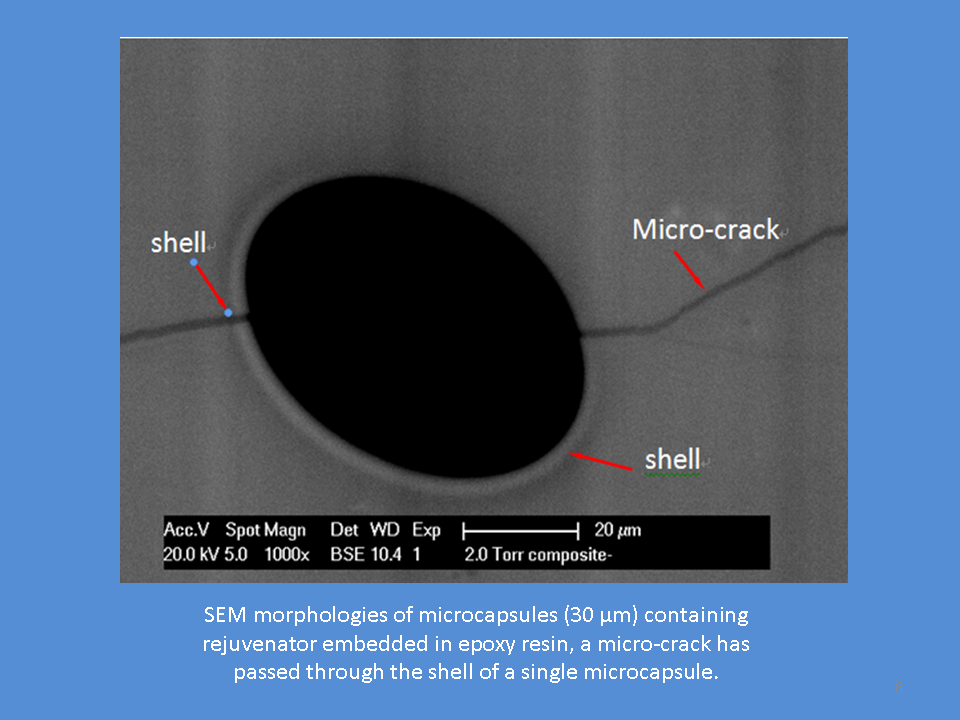
Jun Feng Su, our specialist in making capsules succesfully made some capsules with rejuvenator inside for self healing of asphalt that are thermally stable.
Below you see some images of the capsules under the ESEM. In the inset graph you see how the capsule perform in the TGA.
MSc thesis Daniel Janssen
Last week Daniel Janssen defended his MSc-thesis on
"Water encaspulation to initiate self healing in cementitious materials"
you can download the thesis by clicking here or from the Literature & videos page.
"Water encaspulation to initiate self healing in cementitious materials"
you can download the thesis by clicking here or from the Literature & videos page.

Sunday, 11 September 2011
RILEM conference Hong Kong
Last week the anual RILEM week was organised, this time in Hong Kong. During the conference Erik presented the work of RILEM TC 221 (Self Healing of Cement Based Materials). If you were not there you can download the presentation here.
Thursday, 1 September 2011
more specimen shapes
Senot increased the number of different specimens in the Porous Network Concrete project.
We now have cylinders of different size, plates but also small beams with a tube of porous concrete inside.
More on this project can be found in the page "Porous Network Concrete". Furthermore a presentation can be downloaded from the "Literature & Videos" page.
We now have cylinders of different size, plates but also small beams with a tube of porous concrete inside.
More on this project can be found in the page "Porous Network Concrete". Furthermore a presentation can be downloaded from the "Literature & Videos" page.
strange equipment in Microlab
Maybe you have visited our Microlab before. You will have noticed that we have a lot of equipment to test cement based material. Since a few weeks some very unusual equipment can be found. We are not sure yet what Henk Jonkers is doing with this. He says that he needs it for making Bacterial Concrete.....


Subscribe to:
Posts (Atom)